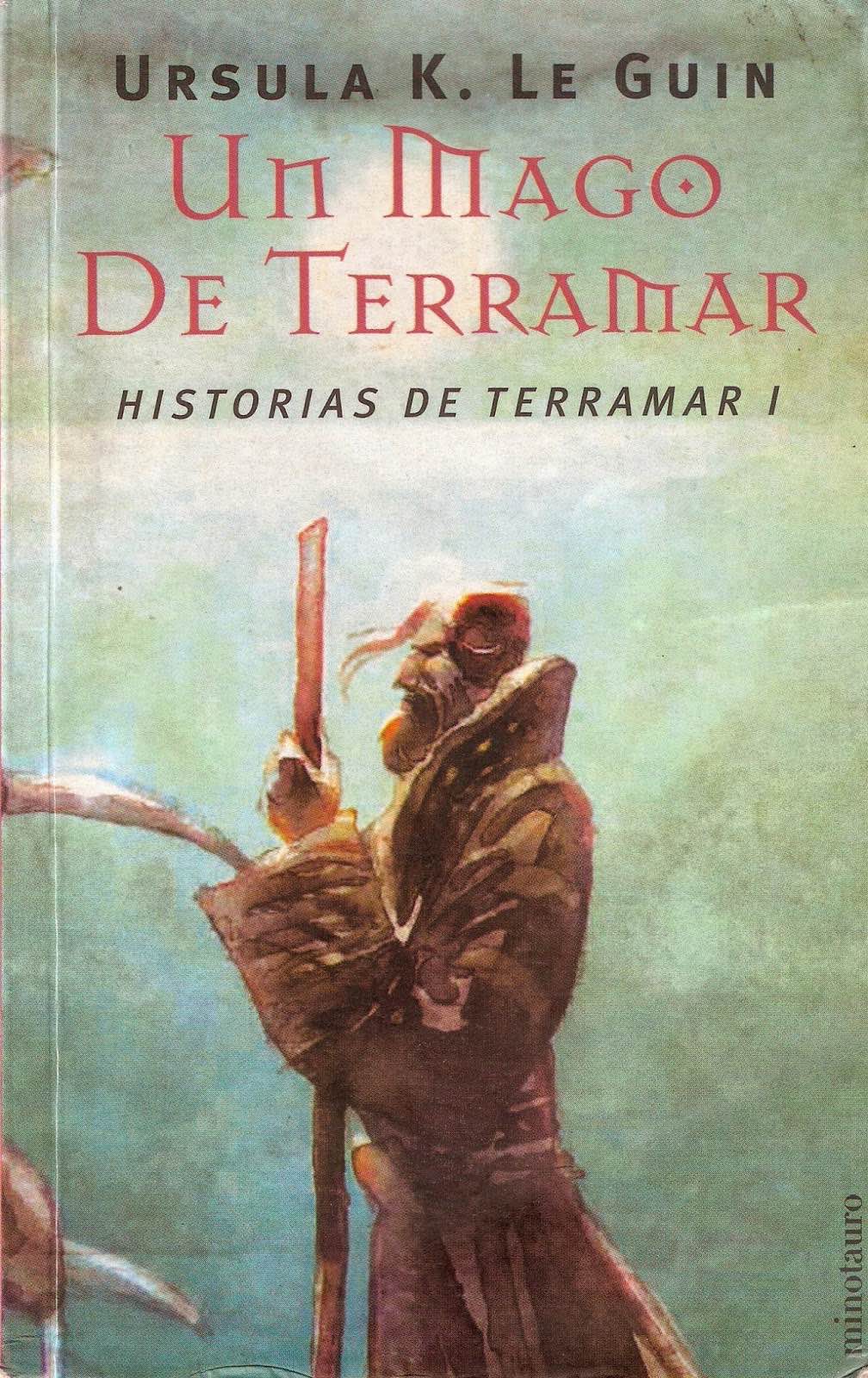
En un mundo en el que el nombre verdadero de las cosas equivale a poder mágico, los magos (sólo pueden ser los hombres) aprenden a nombrarlas para manipularlas y usarlas, pero siempre con cuidado: el equilibrio del mundo está en juego cada vez que un nombre habla palabras verdaderas. Un niño excepcional nace a la sombra de ese mundo: tiene una relación especial con el nombre verdadero de todas las cosas. Su corazón de niño altivo y poderoso irá cambiando hasta convertirse en un hombre increíble.
Pero, como siempre ocurre en Terramar, un individuo no es lo más importante. Sólo el equilibrio del mundo.
I did really enjoy reading this, and will almost certainly go on to read the other Earthsea books.
I came to Earthsea after reading several of Le Guin's Hainish cycle books and short stories, including some of the earliest ones like Rocannon's World. I can see similarities with the earliest Hainish cycle works, from around the same time - an emphasis on male characters, for example - which I am sure would have been handled differently by the same author had she written them later on. But there are still a lot of great ideas here, and it is far more open-minded than most fantasy literature of its era.
I've just never gotten around to reading Earthsea, so I finally did it, and it was an enjoyable fantasy novel that is technically YA but doesn't feel icky reading as an adult.
Do yourself a favor and read the author's afterword at the end. It's a nice perspective and a wonderful message by Ursula K. Le Guin, who has such an amazing talent and voice.
Satisfying ending, but kind of a slog to get there
2 estrellas
I think I would've liked this more when I was 14.
I don't know what I was expecting with this, but I guess it wasn't a pretty bog standard fantasy wizard novel with all the trimmings, and more than a few tired tropes.
I suppose you could point out that this novel was written at a time when modern fantasy novel basically meant Lord of the Rings, when a lot of these tropes were new, and with this book Le Guin literally invented the young wizard coming of age subgenre.
You might even excuse the patriarchal society of Earthsea — including the shockingly unchallenged assertion that "women's magic" is weaker than "men's magic" — as a reflection of the patriarchal 1960's US society Le Guin wrote it in. Certainly, in the afterword of the edition I read, Le Guin talks about how she felt writing about a young brown-skinned teen …
I think I would've liked this more when I was 14.
I don't know what I was expecting with this, but I guess it wasn't a pretty bog standard fantasy wizard novel with all the trimmings, and more than a few tired tropes.
I suppose you could point out that this novel was written at a time when modern fantasy novel basically meant Lord of the Rings, when a lot of these tropes were new, and with this book Le Guin literally invented the young wizard coming of age subgenre.
You might even excuse the patriarchal society of Earthsea — including the shockingly unchallenged assertion that "women's magic" is weaker than "men's magic" — as a reflection of the patriarchal 1960's US society Le Guin wrote it in. Certainly, in the afterword of the edition I read, Le Guin talks about how she felt writing about a young brown-skinned teen wizard who doesn't even rescue any damseled girls, she was already pushing tropes as far as she felt she could if she wanted to get published.
And that seems all fair and reasonable given the historical context. But unfortunately, I'm not sure historical context makes for a good read.
Like I said, I think I would've liked this better in middle school, when I was a much less critical reader and much more prone to getting swept up in adventure.
I did enjoy the ending. It was satisfying in a way that I wasn't expecting. It might've been that I was too distracted by the things that annoyed me to notice the foreshadowing (no pun intended) but I feel like Le Guin held her cards very close to her chest on this one. And it pays off instantly the moment you get there, so I'm glad that I didn't give up on it. I just wish some of the journey to get there had be a bit less tedious.