
Lost in the loop
3 estrellas
I discovered the writings of Douglas Hofstadter three or four years ago, when I started reading his most famous work: Gödel, Escher, Bach. I found it both refreshing and very messy. There were some wonderful analogies like the brain as an ant colony that really stuck with me, but overall, the structure and argument were so convoluted that, by the end, I had to admit I wasn’t sure what the book was really about or what its main thesis was. The self-referential style, with chapters reflecting the concepts they describe was definitely funny but it certainly didn’t help my understanding.
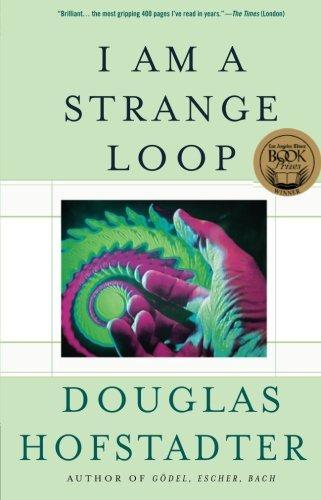
Over the years, I’ve read most of Hofstadter’s books with great pleasure, and recently I decided to take on I Am a Strange Loop. In the preface, Hofstadter explains that his goal was to revisit the ideas of Gödel, Escher, Bach in a more straightforward way, because many …
I discovered the writings of Douglas Hofstadter three or four years ago, when I started reading his most famous work: Gödel, Escher, Bach. I found it both refreshing and very messy. There were some wonderful analogies like the brain as an ant colony that really stuck with me, but overall, the structure and argument were so convoluted that, by the end, I had to admit I wasn’t sure what the book was really about or what its main thesis was. The self-referential style, with chapters reflecting the concepts they describe was definitely funny but it certainly didn’t help my understanding.
Over the years, I’ve read most of Hofstadter’s books with great pleasure, and recently I decided to take on I Am a Strange Loop. In the preface, Hofstadter explains that his goal was to revisit the ideas of Gödel, Escher, Bach in a more straightforward way, because many readers had apparently missed the main point about the nature of consciousness. That sounded promising: I was ready for the clarity I had been missing!
Unfortunately, Hofstadter seems unwilling to let go of his usual style. Once again, the book is full of analogies, digressions, and personal anecdotes. What could probably be a 15-page essay ends up stretching across nearly 600 pages. Along the way, we learn how and why he became a vegetarian, his experiments with video feedback loops, how he coped with the grief of losing his wife, and of course, detailed explorations of Gödel’s incompleteness theorems. All of this is interesting and somehow loosely related to his point, but it makes the book feel sprawling and unfocused.
So once again, I enjoyed I am a strange loop, although I skimmed through some chapters, but I’m now more convinced than ever that Hofstadter’s theory of consciousness is essentially just a strong intuition. There’s no data, no evidence, only analogies. This becomes especially clear in the contrast between the rigor of Gödel’s proof and the vagueness of Hofstadter's claim, which boils down to something like: “Gödel-like recursion in the mind should give rise to consciousness.” It’s a beautiful idea, but it lacks precision. So while I keep finding Hofstadter’s intellectual creativity admirable, as his work occupies a special place between science, philosophy and art, I'm still looking for a clear definition of the concept of "strange loop".